

 bhargava
If you just finished your AP EAPCET 2026 exam and you’re already Googling “AP EAPCET 2026 marks vs rank” – trust me, you’re not alone. Every year, lakhs of students across Andhra Pradesh go through this same anxiety-filled wait: Did I score enough? Which rank will I get? Will I get CSE in a decent college?
The truth is, your AP EAPCET rank is the single most important number that will shape your next four years of engineering. And the smarter you are about understanding it – before counselling even begins – the better your chances of landing the branch and college you actually want.
In this guide, we break down everything: the marks vs rank analysis, expected cutoffs for 2026, which colleges open at which ranks, and most importantly – how to use the free AP EAPCET College Predictor on EduVale to shortlist your colleges in minutes.
Let’s get straight to it.
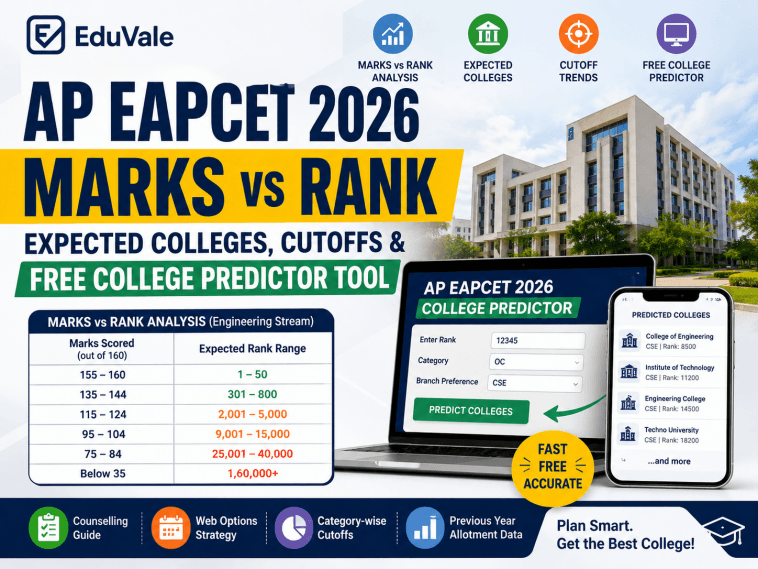
AP EAPCET 2026 Marks vs Rank Analysis – What Score Gets You What Rank?
One of the most common questions after the exam is: “I scored X marks – what rank will I get?” The honest answer is – it depends on a few factors like the difficulty level of the paper, total number of candidates, and the normalization process. But based on historical AP EAPCET trends from 2021–2024, here’s a realistic marks vs rank estimate for 2026:
AP EAPCET 2026 Expected Marks vs Rank Table (Engineering Stream)
💡 Note: These are estimates based on previous year trends. Actual ranks may vary by ±10–15% depending on paper difficulty.
| Marks Scored (out of 160) | Expected Rank Range |
|---|---|
| 155 – 160 | 1 – 50 |
| 145 – 154 | 51 – 300 |
| 135 – 144 | 301 – 800 |
| 125 – 134 | 801 – 2,000 |
| 115 – 124 | 2,001 – 5,000 |
| 105 – 114 | 5,001 – 9,000 |
| 95 – 104 | 9,001 – 15,000 |
| 85 – 94 | 15,001 – 25,000 |
| 75 – 84 | 25,001 – 40,000 |
| 65 – 74 | 40,001 – 60,000 |
| 55 – 64 | 60,001 – 85,000 |
| 45 – 54 | 85,001 – 1,20,000 |
| 35 – 44 | 1,20,001 – 1,60,000 |
| Below 35 | 1,60,000+ |
What This Table Actually Means for You
Scored above 120? You’re in a strong position. A rank below 5,000 gives you genuine access to top NIT-equivalent private colleges, JNTUA affiliated institutions, and CSE/ECE branches in well-ranked colleges across Andhra Pradesh.
Scored between 90–120? This is the most competitive band. Ranks between 5,000 and 20,000 can still fetch you good colleges and decent branches – but your web options strategy during counselling will make or break it.
Scored between 60–90? Ranks in the 25,000–60,000 range are workable, especially with reservation benefits. Branches like Mechanical, Civil, EEE, and ECE are accessible. CSE at top colleges may be out of reach, but there are still quality options.
Scored below 60? It gets tough for premium colleges, but a well-planned counselling approach (especially for BC/SC/ST categories) can still get you into a recognized institution.
🔎 Don’t guess – verify. Once AP EAPCET 2026 results are out, use the AP EAPCET College Predictor on EduVale to instantly see which colleges are realistically available for your specific rank, category, and branch preference.
AP EAPCET 2026 Rank vs Expected Colleges – What Can You Get?
Let’s break this down by rank band. This is the section most students really need, so we’ve tried to be as specific as possible based on previous year closing rank data.
Rank Below 1,000 – The Top Tier
If you’re in this bracket, congratulations. You’re among the top 0.5–1% of all AP EAPCET candidates. At this rank, almost every college and every branch is on the table.
What’s accessible:
- JNTU Anantapur (JNTUA) constituent colleges
- SRM AP, VIT-AP, Amrita Amaravati – private universities with excellent placements
- NRI Institute of Technology, Sri Vasavi Engineering College
- CSE, AI/ML, Data Science – your pick, practically anywhere
- Top colleges in Vijayawada, Visakhapatnam, Tirupati zones
Pro tip: Even with a rank under 500, don’t skip web options strategy. Many students with top ranks get complacent and miss out on premium private colleges by not exploring all options.
✅ Check your exact college list: AP EAPCET College Predictor 2026
Rank 1,000 – 5,000 – Strong Position
This is still a very competitive rank. You have excellent options across the state.
What’s accessible:
- Most top private engineering colleges in AP
- CSE, ECE, EEE at reputed institutions
- AI/ML and Data Science branches at newer colleges
- Colleges like Vignan’s Foundation, KL University (through EAPCET), Sri Sivani
- Dual degrees and integrated programs at some campuses
What to watch out for: CSE at the absolute top-tier colleges (like VIT-AP or SRM AP) might have closing ranks under 1,000 in OC category – so run the numbers before you finalize your web options list.
🎯 Use the College Predictor Tool to filter by rank, branch, and district – it saves hours of manual research.
Rank 5,000 – 10,000 – Good, Strategic Planning Needed
Students often panic at this rank range, but they shouldn’t. There are still hundreds of quality colleges available. The key is being strategic.
What’s accessible:
- Mid-tier private colleges with NAAC accreditation
- ECE, EEE, Mechanical in good colleges
- CSE in colleges ranked below the top 10 in AP
- District-level autonomous colleges
What you might miss: CSE at premium colleges unless you have category reservation (BC/SC/ST/EWS). This is where category-wise cutoffs matter a lot.
| Branch | Approx. Opening Rank (OC) | Approx. Closing Rank (OC) |
|---|---|---|
| CSE | 100 | 8,000–15,000 (varies by college) |
| ECE | 500 | 12,000–22,000 |
| EEE | 800 | 18,000–30,000 |
| Mechanical | 1,200 | 25,000–45,000 |
| Civil | 2,000 | 35,000–60,000 |
| Chemical | 3,000 | 40,000–70,000 |
📊 These numbers vary significantly by college. Always cross-check with actual allotment data – available at AP EAPCET College Wise Allotment Tool which pulls real data from previous counselling rounds.
Rank 10,000 – 25,000 – Plenty of Options, Smart Choices Required
This is the largest band of competitive students. AP has hundreds of engineering colleges, and at this rank range, the challenge isn’t finding a college – it’s finding the right college.
What’s accessible:
- Large number of JNTUA/JNTUK affiliated colleges
- ECE, Mechanical, Civil at reputed colleges
- CSE at Tier-2/Tier-3 colleges
- IT and Computer Science variants
What students often ignore here: Many students at this rank rush to pick CSE at a mediocre college over ECE at a strong one. ECE from a well-ranked college often has better placement outcomes than CSE from an unknown institution.
💡 Always check the college’s placement records, not just the branch name.
🔍 Check AP EAPCET College Wise Allotment Data to see the exact closing ranks from previous years for any college-branch combination you’re targeting.
Rank 25,000 and Above – Don’t Panic, Plan Smart
A rank above 25,000 still gets you into engineering – but it requires careful planning, especially around category reservations and branch preferences.
What’s accessible:
- Numerous colleges in rural AP districts
- Non-CSE branches at decent colleges
- Colleges under management quota in some cases
- CSE in newer or smaller private colleges
Category reservation is your game-changer here. If you belong to BC-B, BC-C, BC-D, SC, or ST categories, your effective competition is much smaller, and your options open up significantly compared to OC candidates at the same rank.
✅ Run your personalized prediction now: AP EAPCET College Predictor for 2026
Best Tool to Predict AP EAPCET 2026 Colleges – EduVale College Predictor
Let’s be direct: there are several “college predictor” tools floating around the internet. Most of them show you generic lists that don’t account for your specific rank, category, or branch preference. And during counselling season, generic information is worse than no information.
The AP EAPCET College Predictor by EduVale is built differently.
What Makes the EduVale AP EAPCET College Predictor Stand Out
🎯 Rank-Based Filtering Enter your exact AP EAPCET rank and get a list of colleges where you have a realistic chance – not just a vague range. The tool uses closing rank data from previous counselling rounds to show you actual probability.
📂 Category Filtering Whether you’re OC, BC-A, BC-B, BC-C, BC-D, BC-E, SC, ST, or EWS — the predictor filters results by your specific category so you see the seats that are actually meant for you.
🧑💻 Branch / Stream Filtering Want CSE? AI & ML? ECE? Civil? You can filter by branch so you only see relevant results — saving you the mental load of scrolling through hundreds of irrelevant entries.
⚡ Fast, Free, and No Login Required No registration. No SMS verification. No hidden charges. Just enter your rank and get your results. This is especially important during the high-stress days right after results are declared.
📈 Built on Historical Cutoff Data The tool is powered by real allotment data from AP EAPCET counselling rounds from previous years — giving you a reliable baseline, not guesswork.
How to Use the College Predictor – Step by Step
- Visit eduvale.in/ap-eapcet-college-predictor
- Enter your AP EAPCET 2026 rank
- Select your category (OC / BC / SC / ST / EWS)
- Choose your preferred branch or leave it open
- Hit “Predict” and review your college list
- Cross-check with allotment data before finalizing web options
AP EAPCET 2026 College Wise Allotment Data – Why This Is More Important Than You Think
Most students focus only on rank prediction – but the smarter move is to study actual allotment data from previous years. Here’s why:
When you see that a particular college closed CSE at rank 8,500 last year, you now have a real benchmark. You know what score to target, and you know how competitive that seat actually is. Without this data, you’re essentially doing counselling blindfolded.
The AP EAPCET College Wise Allotment Tool on EduVale gives you access to this exact information – organized by college, branch, and category.
How Allotment Data Helps Your Counselling Strategy
1. Understanding Closing Ranks Every seat allotted during counselling has an opening and closing rank. The closing rank tells you the last candidate who got that seat. If that rank is 9,200 for CSE-OC at College X, and your rank is 8,800 — you have a real chance.
2. Spotting Trends Across Rounds AP EAPCET counselling happens in multiple rounds (typically 3–4). Closing ranks almost always increase (worsen) from Round 1 to Round 3 for popular branches, as seats fill up. The allotment tool helps you track these patterns.
3. Category-Wise Analysis Seats are divided across OC, BC, SC, ST, and EWS. A college that looks “full” for OC may still have open seats for BC categories in Round 2. The allotment data makes this visible.
4. Branch-Wise Comparison Across Colleges Sometimes two colleges in the same district have very similar closing ranks for the same branch. You can use the allotment data to decide between them based on additional factors like infrastructure, placements, and NAAC grade.
📊 Explore AP EAPCET College Wise Allotment Data Here — real data, real trends, no guesswork.
What the Allotment Data Typically Looks Like (Sample)
| College Name | Branch | Category | Phase 1 Closing Rank | Phase 2 Closing Rank | Phase 3 Closing Rank |
|---|---|---|---|---|---|
| Sample College A | CSE | OC | 6,200 | 7,800 | 9,500 |
| Sample College A | ECE | OC | 9,800 | 12,500 | 15,200 |
| Sample College B | CSE | BC-B | 11,000 | 14,200 | 18,500 |
| Sample College B | Mech | OC | 22,000 | 28,000 | 34,000 |
| Sample College C | CSE | SC | 25,000 | 32,000 | 40,000 |
Note: Values above are illustrative. Check actual data at the AP EAPCET College Wise Allotment Tool.
This kind of data shows you exactly how seats are filling up round by round — helping you decide whether to take a confirmed seat in Round 1 or wait and gamble on a better option in Round 2.
AP EAPCET 2026 Counselling Tips – Build Your Web Options Like a Pro
Students often make a common mistake during counselling: they either fill too few web options (leaving themselves vulnerable) or fill them randomly (wasting choices). Here’s how to actually do it right.
The Three-Tier Web Options Strategy
Think of your web options list in three categories:
🌟 Dream Colleges (Top 10 on your list) These are colleges slightly above your safe rank — where your chances are 20–40%. You probably won’t get them, but there’s a non-zero probability. Put your absolute dream college-branch combos here.
✅ Safe Colleges (Middle 15–20 options) These are colleges where your rank comfortably falls within the previous year’s closing rank range. This is your bread-and-butter zone. Prioritize college quality here, not just branch.
🛡️ Backup Colleges (Last 10–15 options) These are colleges where you’re almost certainly going to get a seat. Don’t skip this tier — it ensures you always have something to fall back on rather than going unallotted.
🧠 Pro tip: Never put a college in your web options list unless you’d actually be willing to join it. Many students add colleges as “fillers” and then end up allotted to them — stuck in a college they never intended to attend.
Key Counselling Tips for AP EAPCET 2026
- Add at least 40–60 web options. More options = more safety net.
- Prioritize branch at top colleges, college reputation at mid-tier. A CSE at a 3-star college beats a CSE at an unknown college every time.
- Understand your reservation category properly — OC, BC, SC, ST, EWS and their respective sub-categories have different seat pools.
- Don’t skip Phase 2 / Spot Rounds — many seats open up in later rounds as students who got better colleges in Phase 1 surrender their original seats.
- Cross-check web options with real allotment data using the AP EAPCET College Wise Allotment Tool before submission.
- Check college-specific requirements — some private colleges have minimum attendance or fee payment norms that differ significantly.
- Don’t follow friends blindly. Your category, rank, and preferences are unique. What works for your friend may not work for you.
Category Reservation – Understanding Seat Pools
In AP EAPCET counselling, seats are divided into:
| Category | Approximate Reservation |
|---|---|
| OC (Open Competition) | 28% |
| BC-A | 7% |
| BC-B | 10% |
| BC-C | 1% |
| BC-D | 7% |
| BC-E | 4% |
| SC | 15% |
| ST | 6% |
| EWS | 10% |
| Special categories (NCC, Sports, etc.) | 2% |
| Management/NRI Quota | 15% |
This matters because a candidate with rank 30,000 under SC category competes in a completely different pool than an OC candidate at the same rank. Your effective competition within your category is much smaller than the overall rank suggests.
Factors That Affect Your AP EAPCET 2026 Rank
Understanding what goes into your rank helps you interpret it correctly — especially when wondering why your marks vs rank doesn’t match someone else’s from a different session.
1. Paper Difficulty Level
AP EAPCET is conducted in multiple sessions/shifts. A tougher paper naturally results in lower scores across the board — but APSCHE applies normalization to equalize this. This means two students who scored 100 marks in different sessions may receive different normalized scores.
2. Total Number of Candidates
More candidates = more competition = higher ranks for the same score. In recent years, AP EAPCET has seen participation from over 3.5 lakh to 5 lakh+ students. Even a small increase in participation can shift rank distributions noticeably.
3. Normalization Process
APSCHE uses a multi-session normalization formula that equalizes paper difficulty. Your raw marks are converted to normalized scores before the final rank is assigned. This is why the marks vs rank table above is an estimate – the exact formula isn’t publicly disclosed.
4. Intermediate Marks Weightage
One major difference in AP EAPCET from many other state entrance exams: your Class 12 (Intermediate) marks contribute 25% to your final rank calculation, while the EAPCET score contributes 75%. This means:
- A student who scores 100 in EAPCET but has 95% in Intermediate can outrank someone with 110 EAPCET marks but only 75% in Intermediate.
- Don’t underestimate the Intermediate marks component — it can shift your rank by thousands.
💡 Many students ignore this 25% weightage and are surprised when their rank doesn’t match their EAPCET score expectations.
5. Reserved Category Benefits
Students from reserved categories (SC, ST, BC-A through BC-E, EWS) don’t just compete in a smaller pool — in many cases, the closing ranks for reserved category seats in top colleges are significantly higher than OC closing ranks for the same seat. This effectively means reserved category students can access better colleges at the same or even higher numerical rank.
AP EAPCET 2026 – Frequently Asked Questions
Q1: What rank can I get with 80 marks in AP EAPCET 2026?
With 80 marks in AP EAPCET 2026 (assuming moderate difficulty), you can expect a rank in the range of approximately 20,000 to 35,000. However, this depends heavily on the Intermediate marks component (25% weightage) and the paper’s difficulty. A student with 80 EAPCET marks and 92% in Intermediate will rank significantly better than someone with 80 marks and 70% in Intermediate. Use the AP EAPCET College Predictor once your actual rank is released.
Q2: What rank will I get with 100 marks in AP EAPCET 2026?
Scoring 100 out of 160 in AP EAPCET typically places you in the 9,000 to 18,000 rank range, again depending on Intermediate percentage, paper difficulty, and normalization. This rank range gives you access to a decent number of colleges, especially for ECE, EEE, and Mechanical branches.
Q3: Is 120 marks good in AP EAPCET 2026?
Yes, 120+ marks is a strong score. It typically corresponds to a rank in the 2,000–5,000 range for a moderate-difficulty paper. At this rank, you can realistically target CSE/ECE at several well-known private engineering colleges in Andhra Pradesh.
Q4: Which colleges can I get with a 10,000 rank in AP EAPCET?
At rank 10,000 (OC category), you can access a large number of colleges offering ECE, EEE, Mechanical, and Civil branches. CSE at mid-tier colleges is also possible. Check the AP EAPCET College Wise Allotment Tool to see exact closing rank data for specific colleges.
Q5: How accurate is the EduVale AP EAPCET College Predictor?
The EduVale AP EAPCET College Predictor is based on actual historical closing rank data from previous AP EAPCET counselling rounds. While it can’t guarantee 100% accuracy (since 2026 cutoffs depend on fresh data), it gives you a highly reliable estimate — accurate enough to build a solid web options strategy. Think of it as a 85–90% reliable guide that eliminates guesswork.
Q6: How can I check AP EAPCET allotment data branch-wise?
You can check branch-wise and college-wise allotment data directly on the AP EAPCET College Wise Allotment page on EduVale. It lets you filter by college name, branch, and category to see previous year closing ranks — exactly what you need before entering web options during counselling.
Q7: Which branch has the highest cutoff in AP EAPCET?
Consistently, CSE (Computer Science Engineering) has the highest cutoff (i.e., lowest closing rank numbers) across virtually all colleges in AP. This is followed by AI/ML, Data Science, and ECE. Branches like Mechanical, Civil, and Chemical typically have more lenient cutoffs — meaning higher-rank students can still get them.
Q8: Does Intermediate percentage matter for AP EAPCET rank?
Yes — significantly. Intermediate marks contribute 25% of the final rank weightage in AP EAPCET. So even with a moderate EAPCET score, a high Intermediate percentage can considerably improve your overall rank. Always factor this in when interpreting marks vs rank estimates.
Q9: How many web options should I fill during AP EAPCET counselling?
There is no upper limit on web options. Counselling experts typically recommend filling at least 40–60 web options, covering dream, safe, and backup categories. The more options you fill (while still being genuine), the better protected you are from going unallotted.
Q10: Can I change my web options after submission in AP EAPCET counselling?
Yes — during the web options entry window, you can modify your list as many times as you want before the final submission deadline. After the deadline, no changes are allowed. Always double-check your final list against actual cutoff data using the AP EAPCET College Wise Allotment Tool before you submit.
Q11: What is AP EAPCET 2026 counselling process?
AP EAPCET 2026 counselling involves certificate verification, web options entry, provisional allotment, and reporting to the allotted college. It’s conducted by APSCHE in multiple phases/rounds. Typically, counselling begins 3–4 weeks after results are declared.
Q12: What rank do I need to get CSE in AP EAPCET?
For CSE at a reputed college in AP (OC category), you generally need a rank below 10,000–12,000. For top-tier colleges (SRM AP, VIT-AP, KL University, etc.), the cutoff can be as low as 500–2,000. For reserved categories, the effective closing ranks are higher. Use the College Predictor Tool for exact targets.
Q13: What happens if I don’t report after getting allotment?
If you don’t report to your allotted college within the specified deadline, your allotment is cancelled. You may lose your seat and could be excluded from subsequent rounds depending on the counselling norms of that year. Always check APSCHE official guidelines for current-year rules.
Q14: Is AP EAPCET rank same as AP EAMCET rank?
Yes — AP EAPCET (Engineering, Agriculture and Pharmacy Common Entrance Test) is the official name for what was earlier called AP EAMCET. The exam and the rank are the same. You may see both terms used interchangeably online.
Q15: Where can I find AP EAPCET 2026 previous year cutoff data?
The most reliable source for previous year cutoff and allotment data is the AP EAPCET College Wise Allotment Tool on EduVale. This tool compiles real allotment data from APSCHE and presents it in a searchable, filterable format — far more convenient than manually going through APSCHE’s official PDF files.
Conclusion – Make Data-Driven Decisions, Not Emotional Ones
Here’s the most important thing to remember as AP EAPCET 2026 results approach: most students make counselling mistakes not because of a bad rank, but because of bad planning.
They spend days obsessing over their marks and rank, but just a few hours on actual college research. They fill web options based on what their friends are doing or what their coaching centre casually suggested. And then they spend four years wondering if they could have done better.
Don’t be that student.
The good news? You have two incredibly powerful, completely free tools that can change how you approach this:
1. AP EAPCET College Predictor by EduVale → Enter your rank, category, and branch preference. Get a personalized list of colleges you can realistically target. Start here, as soon as your rank is out.
2. AP EAPCET College Wise Allotment Tool by EduVale → Dig into actual previous year closing rank data for any college-branch-category combination. This is how you validate your web options list before the final submission.
Together, these two tools cover everything you need for smart, data-driven AP EAPCET counselling. Use the predictor to shortlist, use the allotment data to verify, and go into web options entry with real confidence.
Your rank got you this far. Now make sure your planning takes you where you actually want to go.
Good luck, and feel free to share this guide with your classmates who are navigating the same journey. 🙌





Comments
Loading…