

 bhargava

MHT-CET 2026: Stop Guessing Your Cutoff and Hack the CAP Rounds
Let’s be completely honest—the time between getting your MHT-CET scorecard and actually sitting in your first engineering lecture is the most stressful part of the entire year.
You’ve spent the last two years solving mock tests, memorizing physics formulas, and losing sleep. But now that the exam is over, you are faced with a completely different kind of test: The CAP Rounds.
Suddenly, you are drowning in a sea of acronyms. What is GOPENS? What is the difference between TFWS and EWS? Should I Freeze or go for Betterment? And worst of all, you are trying to figure out if your hard-earned percentile is actually enough to get you into a good college.
If you are currently trying to read the official DTE (Directorate of Technical Education) cutoff PDFs and feeling like you are trying to decode an ancient language, take a deep breath. You are not alone, and there is a much, much smarter way to do this.
The “PDF Nightmare” (And Why You Should Stop Using Them)
Every year, the State CET Cell releases the official cutoff lists for engineering colleges in Maharashtra. And every year, it is a complete disaster for students trying to read them.
Here is what usually happens: You download a 1,500-page PDF on your phone. You try to use the “Find” feature to search for “Pune Institute of Computer Technology.” The PDF freezes. When it finally loads, you have to scroll past dozens of branches you don’t care about, just to find a tiny, blurry table filled with numbers that make no sense.
Furthermore, the official PDFs only show you the absolute lowest cutoff number for a category.
Why does that matter? Because a single cutoff number doesn’t tell the whole story.
Did that last student get in because of a massive drop in Round 3?
Are there other students with your exact percentile who got admitted?
Was the seat allotted through MHT-CET or the JEE Main All India Quota?
When you are filling out your Option Form—which literally decides your career—you cannot afford to guess. You need exact data.
Why “College-Wise Allotment Details” Are Your Secret Weapon
Most students make the mistake of looking at cutoffs globally, completely ignoring how individual institutes behave across multiple rounds. When you look at college-wise allotment details, you are looking at the exact blueprint of how a specific college fills its classrooms.
Here is why analyzing allotment details at the college level changes everything:
Tracking True Branch Dynamics: A college might have a reputation for high cutoffs, but a deeper look into its college-wise allotments might reveal that newer branches—like Computer Science (Artificial Intelligence and Machine Learning) or Data Science—had significantly lower closing ranks compared to pure Computer Engineering.
Spotting Seat Conversions: In later CAP rounds (especially Round 3), seats reserved for specific categories that remain unfilled are often converted into general seats. By looking at individual student allotments row-by-row for a specific college, you can see if students with lower percentiles suddenly grabbed open seats near the end of the process.
The Shift Component: Many premium colleges operate in multiple shifts or have specific institutional quotas. College-wise allotment tracking lets you see the exact rank variance between Shift 1 and Shift 2 for the identical branch on the same campus.
The Cheat Code: EduVale’s College Cutoff Explorer
This year, you can skip the PDF headache entirely.
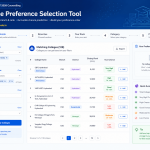
To help students navigate the complex web of institute choices, we built the EduVale MHT-CET College Cutoff Data Tool. Think of this tool as a hyper-fast search engine built exclusively for Maharashtra engineering admissions. It takes all the raw, confusing data from the official government servers and turns it into a clean, easy-to-read list.
How this tool gives you an unfair advantage:
Search, Don’t Scroll: Instead of endlessly scrolling, just type the name of the college you want into the smart search bar. Select the branch (e.g., Computer Engineering), and hit enter.
See the Actual Students: Instead of just giving you a random “minimum cutoff” number, the tool displays the actual official merit list of admitted students. You can see exactly who got in, ranked from the topper all the way down to the last admitted student.
Crystal Clear Categories: See exactly what category the student belonged to (OBC, SC, ST, OPEN) and their gender. No more guessing if a seat was a General seat or a Ladies quota seat.
MHT-CET vs. JEE Main: The tool clearly separates which students secured their seats using their state MHT-CET score and which ones used their All India JEE Main score.
Round-by-Round Tracking: You can see exactly which CAP Round (1, 2, 3, or 4) a student was allotted their seat. This is crucial for predicting how much a college’s cutoff will drop in later rounds.
If you want to know exactly what percentile you need for your dream college, go use the Cutoff Explorer right now.
How to Build the Perfect CAP Round Option Form
Having the right data is only half the battle. The other half is strategy.
When the CAP (Centralized Admission Process) begins, you will be asked to fill out an Option Form with a list of your preferred colleges and branches. The algorithm will look at your merit rank and try to give you the highest college on your list that you qualify for.
Here is how to hack the option form like a pro:
1. The 3-Tier Strategy
Never fill your option form with only top-tier colleges. If the cutoffs spike this year, you could end up with zero allotments in Round 1. Organize your list into three distinct tiers:
Tier 1: The Dream Colleges (Top 20% of your list): Put the top colleges here (like VJTI, COEP, SPIT). Even if their previous year cutoff was 2-3 percentile higher than your current score, put them at the top. Miracles happen, and cutoffs can drop.
Tier 2: The Realistic Colleges (Middle 60% of your list): This is your strike zone. Use the EduVale tool to find colleges where the closing rank last year perfectly matches your current rank.
Tier 3: The Safety Net (Bottom 20% of your list): These are colleges where the cutoff is significantly lower than your percentile. You are 100% guaranteed to get these. They act as your backup parachute.
2. Understand “Betterment” (Float) vs. “Freeze”
This is where most students make a massive mistake.
If you are allotted your Preference #1 college in Round 1, the system will “Auto-Freeze” it. You must take admission there, and you are kicked out of the next rounds. (This is why you must NEVER put a college you don’t actually want at the #1 spot!).
If you are allotted your Preference #4 college, you have a choice:
Freeze: You accept the 4th preference, pay the seat acceptance fee, and your admission journey ends.
Betterment (Float): You pay the seat acceptance fee to hold your 4th preference seat, but you participate in Round 2 to see if you can upgrade to your 1st, 2nd, or 3rd preference. If you get an upgrade, your old seat is canceled. If you don’t get an upgrade, you still get to keep the 4th preference seat! Always choose Betterment if you aren’t completely satisfied.
3. Stop Chasing the “CS” Hype
Listen closely: Computer Science (CS) is great, but it is not the only path to a successful tech career. Because everyone wants CS, the cutoffs are artificially inflated. A 95 percentile might get you into a very average college for CS, but that same 95 percentile could get you into a top-tier, prestigious college if you choose Electronics & Telecommunication (ENTC) or Electrical Engineering.
When massive IT companies come to a good campus for placements, they almost always allow ENTC students to sit for the software developer interviews alongside the CS students. A good college brand name often matters more than having “Computer” in your degree title.
Take Control of Your Future
The engineering admissions process is designed to be a test of your patience, but it doesn’t have to be a blind guessing game. You have the data at your fingertips now.
Take an hour today. Sit down with your parents or a mentor, open the EduVale Cutoff Data Tool, and start building your realistic college list. Check the exact percentiles, look at the college-wise round drops, and map out your strategy.
You’ve worked too hard to leave your college admission up to luck. Take control of the data, and go claim your seat!




Comments
Loading…