

 bhargava
Every year, thousands of students prepare extensively for the Telangana Engineering, Agriculture and Pharmacy Common Entrance Test (TG EAPCET). While securing a good rank is important, many students fail to realize that the counselling process is equally critical. One of the most important stages of counselling is the web options entry process.
A student’s final college allotment is not determined by rank alone. The order in which colleges and branches are entered during counselling plays a significant role in deciding the seat that is ultimately allotted. Because of this, students should invest time in understanding web options, researching colleges, and preparing a proper preference list before the official counselling schedule begins.
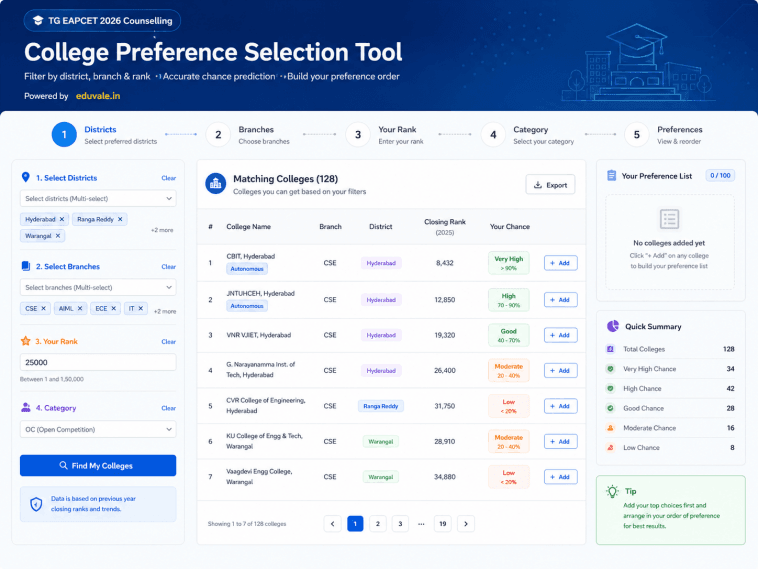
To simplify this process, many students now use online planning tools such as the TG EAPCET Web Options Generator available at https://eduvale.in/tg-eapcet/web-options-generator/.
In this guide, we will explain everything students need to know about TG EAPCET web options, option entry strategy, college preference planning, and how to avoid common mistakes during counselling.
Understanding TG EAPCET Web Options
TG EAPCET web options are the college and branch preferences submitted by students during the counselling process.
After certificate verification and registration are completed, students are allowed to log in to the counselling portal and select engineering colleges and branches in the order they prefer.
The counselling software processes these options sequentially. It checks each preference based on:
- Student rank
- Reservation category
- Gender
- Local area rules
- Seat availability
- Option priority
The system attempts to allot the highest possible option available according to these factors.
This means that the order of options entered by a student is extremely important.
Why Web Options Matter More Than Many Students Think
Students often focus entirely on obtaining a good rank and pay very little attention to counselling preparation.
However, counselling is where admission decisions are actually finalized.
Two students with identical ranks can receive different allotments depending on how they structure their web options.
A student who researches colleges carefully and creates a detailed preference list often achieves a better outcome than someone who enters options randomly.
This is why education experts consistently advise students to prepare their option entry list well before the official web options window opens.
What Happens During Option Entry?
During option entry, students can select hundreds of college and branch combinations.
For example, a student may be interested in:
- Computer Science Engineering
- Artificial Intelligence
- Data Science
- Electronics and Communication Engineering
They may also have location preferences such as:
- Hyderabad
- Rangareddy
- Medchal
- Warangal
Combining multiple branches and districts can quickly result in a large number of possible options.
Managing these combinations manually can become difficult, especially when students are trying to organize options according to personal priorities.
This is one reason why planning tools have become increasingly popular among TG EAPCET aspirants.
Common Mistakes Students Make During Web Options Entry
Every year, counselling authorities and education counselors observe the same set of mistakes.
Adding Too Few Options
Some students enter only 10 to 20 options.
This significantly reduces the chances of receiving a favorable allotment.
A broader preference list usually provides more opportunities.
Following Someone Else’s List
Every student has different interests, career goals, financial considerations, and location preferences.
Copying another student’s option list is rarely a good strategy.
Ignoring Branch Preference
Many students choose colleges solely based on popularity without considering whether they are genuinely interested in the branch they select.
Students should think carefully about the subjects they will study for the next four years.
Not Researching Colleges
Students often add colleges without checking:
- Facilities
- Accreditation
- Available branches
- Infrastructure
- Campus environment
- Academic reputation
Proper research should always be completed before finalizing web options.
Waiting Until the Last Day
Option entry should not be treated as a last-minute activity.
Students who prepare early usually make better decisions and experience less stress.
How to Build an Effective College Preference List
Creating a good preference list requires balancing multiple factors.
Academic Interests
Students should first identify the branches they genuinely want to pursue.
Choosing a branch simply because it is currently popular may not be the best long-term decision.
College Quality
Factors worth evaluating include:
- Academic standards
- Faculty strength
- Industry exposure
- Campus facilities
- Student support systems
- Alumni network
Location Preferences
Some students prefer colleges near home while others are comfortable relocating.
Location often influences travel expenses, accommodation choices, and overall student experience.
Career Goals
Students interested in software development, electronics, core engineering, data science, artificial intelligence, cybersecurity, or entrepreneurship should consider how their chosen branch supports those ambitions.
Why Students Use a Web Options Generator
Preparing hundreds of college and branch combinations manually can be challenging.
Students must often compare:
- Multiple districts
- Different branches
- Reservation categories
- Personal priorities
The TG EAPCET Web Options Generator developed by EduVale helps simplify this process.
The tool allows students to:
- Enter their rank
- Select category and gender
- Filter colleges by district
- Filter colleges by branch
- Generate a structured preference list
- Rearrange options easily
- Print their final list for counselling preparation
Students can access the tool here:
https://eduvale.in/tg-eapcet/web-options-generator/
The goal is not to replace official counselling but to help students prepare a more organized and thoughtful option entry list before the official process begins.
Researching Colleges Before Counselling
A well-informed student always researches colleges before adding them to their preference list.
Factors that should be reviewed include:
- College location
- Available courses
- Approval status
- Accreditation details
- Infrastructure
- Establishment history
- Campus facilities
Students looking for detailed information about engineering colleges can use the EduVale College Directory:
https://eduvale.in/college-directory/
The directory provides a centralized place to explore colleges and compare different institutions before counselling.
Estimating Potential College Opportunities
Many students also want to understand which colleges may be available based on their rank.
While no tool can guarantee admission, historical trends can provide useful guidance.
Students can explore the TG EAPCET College Predictor at:
https://eduvale.in/eapcet-college-predictor/
This helps students gain a better understanding of possible college options and supports more informed counselling decisions.
Preparing for Counselling Success
The most successful students generally follow a structured approach:
- Understand the counselling process.
- Research colleges thoroughly.
- Decide preferred branches.
- Create a large and well-balanced option list.
- Include both ambitious and realistic choices.
- Review preferences carefully before submission.
- Keep updated with official counselling notifications.
Following these steps can help students approach counselling with greater confidence.
Final Thoughts
TG EAPCET counselling is one of the most important stages of the admission journey. A good rank creates opportunities, but thoughtful planning during web options entry helps students make the most of those opportunities.
Instead of rushing through option entry at the last minute, students should spend time understanding colleges, exploring branches, and organizing their preferences carefully.
Using resources such as the EduVale TG EAPCET Web Options Generator, College Directory, and College Predictor can make the preparation process more structured and efficient.
A well-planned preference list does not guarantee a particular allotment, but it does help ensure that students make informed decisions that align with their academic interests, career goals, and personal priorities.
The students who prepare early are often the students who make the best counselling decisions.





Comments
Loading…